|
Guns Defense or, What to Do When "Ruh Roh!" Happens
By
--)-Rapier
--, Fighter Ace
Content Manager
| "Being under fire is bad for the nervous system." |
| - Captain Willy Coppens, Belgian Air Force 37 victories |
| "A MiG at your six is better than no MiG at all." |
| - Unknown |
| "The guy you don't see will kill you." |
| - Brigadier General Robin Olds, USAF 9.5 victories |
| "Look around - what you see won't hurt you. Keep your head out and use it." |
| - Captain Thomas J. Lynch, USAAF 20 victories |
The only thing worse for your nervous system than being under fire is the sound of lead hitting your virtual airframe. Continued application of bullets can ruin your entire flight. Proper guns defense is a broad topic, and indeed entire books have been written about it. Like most ACM topics, each segment of guns defense is related to the others. You cannot fixate on just one aspect and be successful. We will try to cover the main points here.
Situational Awareness
The first aspect of guns defense is what is known in the fighter pilot community as situational awareness, or SA for short. SA is the ability of the pilot to keep track of all the planes in the sky, both friendlies and bad guys. Each individual has a greater or lesser amount of SA, and SA can change as conditions change. Pilots' can have their SA overloaded when there are too many targets and friendlies in the air to track. Pilots who can handle three targets simultaneously may find themselves overloaded by the sudden arrival of a fourth, particularly if that fourth is moving in a radically different plane of maneuver from the other three. SA is also a function of learning. A pilot can learn to increase SA through repetition and thinking about the typical movement of planes in a battle. Fatigue and mental state are also factors that can positively or negatively affect SA.
As a virtual fighter pilot, you should be working to increase your situational awareness every time you fly. Look around all the time. When taking off, immediately ascertain where planes are all around you. Continue to track them once you are off the ground, and try to predict where they will be in a few seconds. Keep in mind the physics of flight. Planes can only move forward, and can't go in reverse. This limits the places they can be N seconds into the future. Planes also find it easier to move downward than upward. If you lose sight of a bogey, unless it was moving fast when you last saw it, it's more likely to have dived than climbed. Knowledge of how a plane flies will help your SA.
Stop Thinking Like a Target!
| "The battle is over when swords cross." |
| - Principle of Tai Chi Chuan |
In nearly every kill that occurs in the arenas, the pilots of destroyed planes knowingly or unknowingly put themselves in a vulnerable position. While it is a lot of fun to dive into the center of a large melee, doing so will probably not extend your virtual life span. If you want to achieve Ace status, then a more thoughtful approach is going to be required.
Many of the key factors in a fight are determined before you engage: what plane you chose to fly; its strengths and weaknesses compared to those of other planes in the arena; the altitude you chose to join battle at; the speed you had accumulated before engaging; and the existing damage to your plane. Consider all of these before engaging.
| "A top World War II ace once said that fighter pilots fall into two broad categories: those who go out to kill and those who, secretly, desperately, know they are going to get killed -- the hunters and the hunted." |
| - General Nathan F. Twining, USAF |
| "There are only two types of aircraft -- fighters and targets." |
| - Major Doyle "Wahoo" Nicholson, USMC |
The pilot who just blindly enters a melee is a target and not a hunter. Think about what hunters do. They prepare themselves, know and ready their weapons, know and study their prey, then carefully stalk it to a successful conclusion. Hunters of the sky carefully evaluate the situation before entering, and only choose to engage when the conditions are to their advantage. So think like a hunter and not a target!
How Shooting Actually Works
Take a look at the related gunnery article. It's under Game Help/Playing the Game/Tips and Tricks/Combat. The main point to keep in mind in this discussion is that the most difficult shot to make is a high angle of deflection (as close to 90 degrees as you can get), moving at high speed at a high rate of closure. This becomes even more difficult when the target is constantly changing its heading and perceived flight path. If you have to give your opponent a shot, make it this kind of shot.
The easiest shots are those from a dead six position, with little or no deflection, at a slow rate of closure. If you've given one of these shots to your opponent, it means you were flying straight, at a low rate of speed. Avoid this condition at all costs!
What to Do When You Get Shot At
| "The great thing is never to let the enemy's machine get behind you, or 'on your tail.' Once he reaches there it is very hard to get him off, as every turn and every move you make, he makes with you. By the same token it is exactly the position into which you wish to get, and once there you must constantly strive for a shot as well as look out for attacks from other machines that may be near." |
| - Lt. Colonel W. A. "Billy" Bishop, RAF 72 victories |
Hopefully this does not come as a surprise to you. With your newfound understanding of SA, you should have been tracking the incoming plane and have your strategy worked out.
Any action is better than none at all.
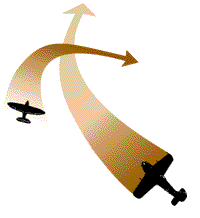
However, you may be living the fighter pilot's worst nightmare, where your first sign of your opponent is a hail of tracers crossing your wing or the sound of bullets hitting your plane. What you do in the next instant will determine whether you survive that flight or not. You need to have worked this out well in advance and be able to do it as soon as it's triggered. Think about what this means. The enemy has you in their gun sight and in range. You need to change this as soon as possible. Any action will be better than none at all, but a well-considered action works far better. You can't immediately do much about being in range, but you can get out of those sights. What you need to do is move immediately as close to 90 degrees across your enemy's path as possible, to create the greatest lateral movement. Crank the stick hard over and use the rudder to help your roll rate. Pull back on the stick hard to get the maximum turn rate going. Once you achieve a wings-vertical attitude, you are at max turn rate, but roll just a bit further, so that you will be pulling your nose down. This allows gravity to help the plane's acceleration and keeps your speed up.
If you have done everything properly, your plane is slicing downward at an angle. Turning downward will make your opponent's gunnery problem more difficult. Their plane, which is probably moving fast already, will be further accelerated as they go nose down to follow you, which increases closure speed. (See above in the How Shooting Actually Works section to see the effects of high closure speed on the gunnery problem.) Keep pulling hard until you calculate that you're 90 degrees from your original flight path, and take a look behind you. If you are lucky, you have temporarily broken your opponent's firing solution, but you're not out of the woods yet. See if your enemy is accelerating out and away from you or cutting it in tight and following you.
| "To hit a machine which is flying at right angles to you across your nose is very hard. It requires a good deal of judgment in knowing just how far ahead of him to aim . . . In our tactics we used this cross shot, as it is called, considerably; mainly when, after a combat has been broken off for some reason, guns having jammed or the engine running badly, it becomes necessary to escape. Upon turning to flee, your opponent is able to get a direct shot at you from behind. This is decidedly dangerous; so, watching carefully over your shoulder and judging the moment he will open fire, you turn your machine quickly so as to fly at right angles to him. His bullets will generally pass behind you during the maneuver." |
| - Lt. Colonel W. A. "Billy" Bishop, RAF 72 victories |
Now it gets interesting. Your opponent basically has two choices: to conserve their energy and use their speed to get back above you and set up a second shot, or cut their speed, pull in behind you, and opt to blast you on this run. This will probably depend on the plane each of you is flying. If your opponent's plane is better at turning, or if your opponent has big guns and is betting on knocking you out in one pass, they will opt to drop in behind you and blast away. What you will see is their plane slew out to the side of your rear view and then move towards the center as they sight in on you. You will need to do some additional pilot things very quickly here, as they're trying to reacquire you in their sights.
If your opponent's forte relative to yours is energy fighting, they will be safest pulling up and regaining energy. You will see your opponent's plane pass out to the upper side of the rear view, and you should regain vision of it to your upper rear quarter. You will have a moment to reset yourself and prepare for the next onslaught. Use this time wisely to maintain or build up your energy. You want to stay close to the speed you need in order to go vertical and pull over the top. This keeps your options open, because you can make any maneuver at this speed. Depending on what your current speed is, you may need to level out or even nose down to regain speed. Excess speed above this should be converted back into potential energy by climbing, but be very careful with this, as getting too slow at the wrong time is a primary cause of death in the arenas.
If your attacker is able to stay in the saddle past the opening break, your best bet is to roll 90 degrees and pull hard to change the plane of maneuver. After that, try some of the following maneuvers.
Other Guns-Defensive Maneuvers (Additional Pilot Things)
Loop or Immelman: Generally a bad idea, as either of these maneuvers will slow you down, making you a better target. Both the loop and Immelman have their place in maneuvering, but used for defense when you are under the gun (no pun intended), they have too many drawbacks. The Immelman (the first half of a loop combined with a half roll to return you to upright position) is useful for reversing direction when you are out of gun range.
Split Esse: This is better, as the downward movement causes the shooter to accelerate, also making their closure rate and turn radius go way up. The drawback is that it loses a lot of altitude and has no horizontal component to it.
Slipping and Skidding: These maneuvers are the result of uncoordinated (crossed) use of the controls, that is, the rudder's not being coordinated with the stick -- using left rudder with right stick, for example. What this does is give mixed messages to the pilot who is trying to shoot you. The direction the plane's nose is pointing may indicate a left turn when you are in fact turning right. Your opponent will use their incredibly brief setup time working for a shot that will not be there. You can be quite successful in avoiding bullets just by doing this.
Barrel Rolls: The barrel roll (stick over and back) is useful in that it maintains your movement along a heading while throwing in lateral movement to take your opponent's aim off. This can be useful combined with slips and skids when your sincerest desire is to bug out and return to base. The drawback is that prolonged barrel rolls will bleed your speed and energy down. Make sure that you have some back pressure on the stick; otherwise, instead of moving laterally, you will be doing an aileron roll, which will not throw your opponent's aim off at all. You can also barrel roll and try to force the overshoot (cause your opponent to pass you) by pulling your throttle back, hitting brakes, dropping gear, and throwing out the virtual anchor.
Conclusion
The main thing in defense is the same as offense. SEE THE BOGEY FIRST! Doing so gives you options. Not doing so makes you a target. Think like a hunter and not like a target. When you get bounced, have it all worked out in advance so that the bounce is the trigger that starts your action. Timing is everything.
| "There is timing in everything. Timing in strategy cannot be mastered without a great deal of practice . . . Timing and rhythm are also involved in the military arts, shooting bows and guns, and riding horses . . . There is timing in the whole life of the warrior, in his thriving and declining, in his harmony and discord . . . If there is a Way involving the spirit of not being defeated, to help oneself and gain honor, it is the Way of strategy." |
| - Miyamoto Musashi, Go Rin No Sho (A Book of Five Rings) 60+ kills in personal combat |
Musashi, Miyamoto. Go Rin No Sho
(A Book of Five Rings). Translated by Victor Harris. Woodstock, New York: The Overlook Press, 1982; pp. 48-50.
Shaw, Robert. Fighter Combat: Tactics and Maneuvering
. Annapolis, MD: United States Naval Institute Press, 1985; pp. 23-31.
Sims, Edward H. The Aces Talk
. Toronto: Ballantine Books of Canada, Ltd., 1972. Formerly published under the title Fighter Tactics and Strategy 1914-1970; p. 89.
|